
Experimenting with AI and poetry
Why involve a machine in something that’s fundamentally human? In other words, why ask the toaster* to make art when it should be tasked with doing the boring things that get in the way of our making meaning? From doing good work? (And from having fun while doing it?)
They are important and relevant questions. Indeed, they’re exactly the sort of questions I sought to encourage in my first essay of the year: “Inviting thoughts about AI in Education.” So it seems fitting to return to those themes in my last essay of the year.
These particular questions arose in the discussion after a course called “Reflecting on Science and Integrity.” As part of the preparation beforehand, my students read the Dutch government’s “government-wide vision on generative AI in the Netherlands.” Four of them—Sabien Bootsma, Aya Ezzedinne, Alysha Keuning, and Frank Götz—then narrowed in on the repeated mention of poetry as a use-case (pp. 3, 9). And I thought they made some great points. So I want to build on those here before we all go on our summer break.
I had already been exploring possible use-cases for AI in Education as part of a larger discussion at the Faculty of Behavioural and Social Sciences (in parallel with discussions at the Teaching Academy, at ENLIGHT, and at NWO). As I considered my students’ questions, it then struck me that following this line of questioning about poetry might actually help us unpack some of the associated concerns about AI in education more broadly.
(I should note too that I have been exploring possibilities while leaving the question of whether we should implement them to others. I understand that these tools use electricity and water, but it’s beyond the scope of my explorations to decide if we shouldn’t use them in educational settings.)
I began by asking a generative AI—an LLM (Anthropic’s Claude)—to generate some poems on psychological topics. Specifically, I wanted poems about Jean Piaget, who has been the focus of much of my historical research for the last twenty years. These, I thought, I could judge for quality (both creative quality and content) without missing anything. I could also treat the AI’s productions like drafts, as if I were using the software for brainstorming (as some have suggested as a use-case), and then revise and rewrite to propose my own poems.
My first forays, unconstrained, were terrible. Just rubbish. “Write some poetry about Piaget” is much too vague as a prompt: the AI clearly needed tighter constraints and greater specificity. So I revised. And I ultimately narrowed in on Formalist Poetry as something that would benefit from machine assistance: Haiku, Limericks, Tankas, Cinquains, and Sijos all have strict rules inside of which one’s creativity can play.
Because I’ve written lots of Haiku (including for Mindwise), I thought I’d try learning limericks. A limerick is a bit like a Haiku: it has five lines, rather than three, and some equally strict rules that define the form.
Haiku don’t need to rhyme. Limericks do: they follow an AABBA rhyme scheme.
Haiku have strict syllable requirements: 5-7-5 across three lines. Limericks do too, although not in the same way: the first two lines are longer, the next two are short, and the long third brings everything together. In addition, the rhythmic pattern of Limerick is meant to follow a form (“anapestic meter”) that feels like it bounces in its emphasis.
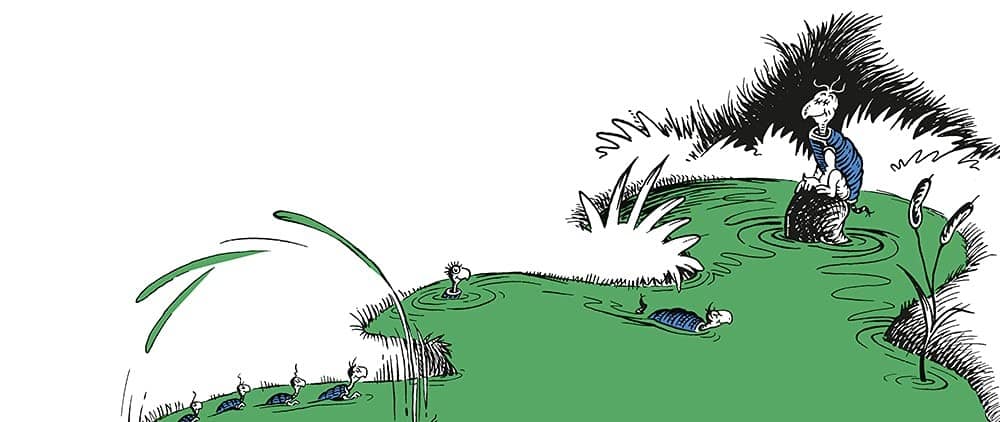
Lots of Dr Seuss books use this form, and you can hear it if you read them out loud. Here, for example, is a passage from Yertle the Turtle, which he originally published in 1951:
| On the far-away Island of Sala-ma-Sond, Yertle the Turtle was king of the pond. A nice little pond: it was clean, it was neat. The water was warm. There was plenty to eat. The turtles had everything turtles might need. And they were all happy. Quite happy indeed. |
 |
Limericks have the same bounciness, but with additional constraints. I’ve just never been able to get them quite right. So I thought that exploring some AI approaches might be fun and interesting: a low-effort way to see if I could learn by doing (with some help).
Here’s a particularly good example of what the toaster suggested for Piaget, and also my multiply edited revision of that result taken as a brainstormed draft. My version came together fairly quickly, following multiple revisions over less than an hour while I was doing other things.
| Claude Sonnet 4.5
A psychologist, Piaget by name, |
JTB’s version
A psychologist-philosopher: his name? |
I don’t like the machine version at all. Piaget’s stages aren’t clear unless you look the way he looked. They aren’t driven by age, but by experience (correlated with age). And mapping is the wrong metaphor, unless it’s used formally in the sense of “isomorphisms” (but there’s nothing given here to suggest that). Still, this was the best of the bunch: something I could work with, if only to help me with the challenging structure.
Side by side, we can definitely see some similarities: four of the five lines start nearly the same way. But historians aren’t interested in fame, as a frame, so I dropped that immediately. I also kept less than half of the AABBA line-ending words, and I rhymed more loosely than the machine with name, same, and change (whose vowel-sounds are the same in my accent). The rhyme between appear and years is loose, too, but could be cleaned up by dropping the S. I decided to keep this, though, because I saw an interesting way to subvert the form in the last line. And the extra S felt like a way to signal this subversion.
Rather than simply not staying the same, children’s minds change. That’s part of Piaget’s dialectic: children’s developing cognition constructs novelties on top of an earlier-developed core, then it reorganizes—accommodates—that core. Here, the core is that vowel sound: a phonological conservation, not an orthographic one. (It’s Seussical!) This is also the same move as in the S-signal. And that repetition makes it seem intentional. The result is a punchier last line, as well as a stronger whole. My version feels like it pays out in ways the machine version doesn’t.
I genuinely love the result. Granted, my version feels rushed in the first line: the meter isn’t quite right. But otherwise I’m quite happy. Especially after explaining everything to myself, and revising further, as I explained it to you. But is it mine? Or is it Claude’s and mine?
This author-ambiguity is a problem for AI in Education. So after making several more attempts, and discussing them with friends and colleagues, I eventually dropped the AI completely. The first truly successful result then borrowed from the brainstorming I had done to revise the name–same rhyme for Piaget. But this time I chose Freud as the subject, since he is ultimately better known to the public, and I wrote my own limerick without any help at all:
Let’s play a Freudian game:
“It’s clear your mother’s to blame!”
So confess your ouch
While you sit on my couch
And I privately dismiss you as tame.
This ticks all of the boxes. To do so, though, it plays with the standard tropes. And the brevity requires an almost stereotypical approach, which we can certainly critique. But it’s clearly marked as a game: we’re playing with “Freud,” not Freud.
As with the Piaget poem, that last line was the most challenging. I rewrote it many times before I was happy with it. But this version works on many levels: it not only follows the rules, but it also echoes things we know about psychoanalysis and the therapeutic relationship. As well as about judgment and power. And the theoretical Freudian Id, which is—famously—supposed to be untamed. There are, in other words, nods and winks included that I suspect an AI would have trouble replicating: the punchline is that this is a salacious therapist hoping for something interesting, and not getting it.
Because I had no machine help in writing the Freud limerick, and it used a format I’ve never successfully followed before, I’d say the experiment was successful. But my larger point in doing this wasn’t to make poetry. It was to explore whether we could use the new tools to make it easier do something difficult that we value; to examine whether there’s a role for AI in augmenting thought, rather than replacing it.
In this, I’d say the experiment was also a success. I managed to create something new: after allowing myself some AI-supported practice with a new form, I gained sufficient comfort with the form to generate my own text (which seems reasonably good in terms of quality). And I enjoyed myself. Especially in combination with the reflection, this then seems like a potentially useful model for our broader thinking about AI in Education.
We can imagine an assignment asking students not only for a poem, or three, but also for their justification of their choices and some explanation of the changes made during revisions. Or, working less creatively, we could think across the curriculum and ask early students to develop AI-assisted drafts—using the tools as a scaffold to expand their Zone of Proximal Development—while eventually working their way toward creating their own texts without that help. This “poetic” approach could then be considered as a vehicle for exploring the discipline and thinking about what we know in new and different ways, while also reflecting on AI literacy (and when it’s more fun to do without).
Do you have ideas about use-cases that could help students to do more, more easily, more enjoyably, and then come away with higher-level abilities that might not otherwise have been possible to learn in the same time? In other words: can you think of ways that AI might scaffold further development without getting in the way? Please share your thoughts below. (Or if you have your own psychological poems, please share those too: that seems like an excellent summer project!)
Image source: Yertel the Turtle by Dr Seuss, 1951/1958
* Hat-tip for this to Sofia Cernakova and Jona Frank


Your essay on poetry’s fine.
What would really make it divine,
Is assume it will mention,
The public perception.
But the expert’s details won’t shine.
Responses to pieces on Mindwise
tend to be short, sort of bite-sized.
A poem is fine,
Or even one line!
But writing them still makes your time fly.
(100% human)
I really liked this, Jeremy! It was interesting and fun to read.
Funny – a few weeks ago I had Claude help me write a poem for a Dutch friend who was starting a new job. I wanted the poem to be in Dutch, which made it harder for me to write – native English speaker here. I did write an in depth prompt (in English) with a lot of context, and had to do a lot of Deepl Translation back and forth. It took about 45 minutes to get something I was finally happy with. It was much harder to include the winks/nods in my non-native language. Luckily I do know enough Dutch that I could still include some, know what felt too “serious” (I wanted it to be fun and playful, and even though the prompt I designed said this clearly, the initial results were not so great), and could change to other words that rhymed from my own mental vocabulary bank.
I was happy that I could create a poem in my (not yet fluent) second language with the help of Claude – something I would truly not have been able to do without the technology.