
A distorted view on creativity
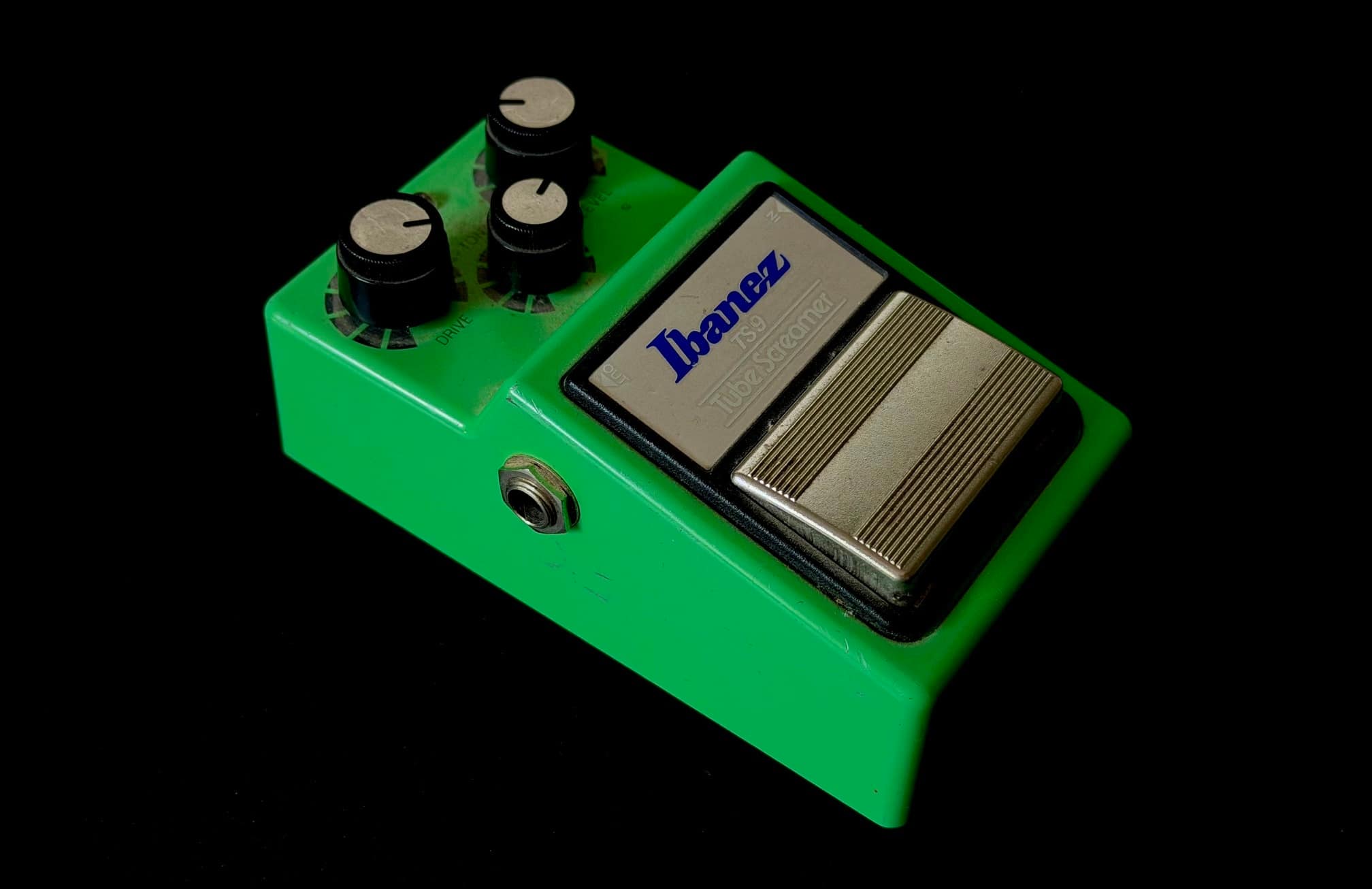
It’s 1989, and I am sixteen years old, standing in the ‘Rock Palace’ music store in The Hague, looking at their collection of effect pedals for electric guitars. A couple of years ago I’ve started playing guitar and, with some classmates, started a heavy metal band. Our limited playing skills aside, getting the right sound is a real challenge – especially on a tight budget. One of my bandmates has already made his decision: he’s going for an Ibanez Tube Screamer. All of us are Metallica fans, and we’ve read in Guitar Player magazine that their lead guitarist Kirk Hammett uses a Tube Screamer, so the choice is easily made…
As you can tell from the fact that I work in this department, our band never really got anywhere… but a career in Psychology has its moments too. Still, the Ibanez Tube Screamer remains fascinating to me; not just because it sounds great, but also because it is a paradox. It does something people don’t want, but actually they really want it. It should not exist, but it does. It couldn’t have been invented, but it was.
To make sense of this, let’s take a step back and look at theories of creativity.
The arrow of the creative process
Psychologists like to emphasize that creativity is a process, not an event: it unfolds over time, and involves different behaviors. For example, an influential model by Jill Perry-Smith and Pier Mannucci describes the ‘journey’ an idea goes through from conception to implementation. Various ideas get generated and the most promising ones get selected; the raw idea gets exposed to feedback, and is improved and elaborated into something closer to a blueprint. The more developed idea is then pitched to people who can provide you with the necessary time, support and other resources. If all goes well, this leads to the final goal: implementation in an actual product or whatever it is you’re trying to make.
Sequences like this make sense, and invite us to theorize about what it takes to successfully move through these various stages. Although creativity researchers often admit that these models are a simplification of a messy and iterative process, typically we leave it at that; we don’t really want to dive into this mess. Thus, ‘stage’ models of creativity mostly suggest that the arrow of creativity points (or should point) forward: a progression from idea to product. The questions we ask typically focus on this progression: How can we get people to identify their most promising ideas? Why do people often resist creative ideas? Why is it so hard for teams to successfully implement their ideas? Not moving forward –not getting a creative idea to the next stage– is a delay, or a failure. Stimulating creativity means helping people (and their ideas) progress through the idea journey.
Stage models of creativity mostly suggest that the arrow of creativity points forward: a progression from idea to product
Although I like these models and the research they inspire, I increasingly find myself thinking that this mischaracterizes a lot of creative work — because the arrow of creativity often points backwards. The most interesting forms of creativity happen when we take a step back: we encounter things and start playing around with them, we run into unexpected obstacles and realize that our idea was too limited, or we come to understand that we were trying to solve the wrong problem in the first place. What all of these ‘steps back’ have in common is that they arise from a confrontation with the real world, which then feeds back into what we think. This is why serendipity is such an important ingredient of creative work. It’s discovery through tinkering, rather than invention through cognition. For example, nobody could have ‘invented’ the Tube Screamer…
Rise of the electric guitar
When the electric guitar was invented, the goal was simply to make a guitar that could still be heard in loud combos: trumpets and saxophones are much louder than an acoustic guitar. When you build an amplifier, your goal is to strengthen the volume (the amplitude) of the sound without distorting it: you just want to make things louder. Amplifier manufacturers do their best to create amps that have as little distortion as possible.
The early guitar amplifiers weren’t that powerful, and guitarists had to dial the volume all the way up –perhaps even to 11!– to remain audible over all those other instruments. But, as anyone who ever organized a party knows, if you turn an amp all the way up, it doesn’t just make things louder: it makes them sound ugly. The sound gets distorted. An undesirable, yet inevitable side effect of pushing an amp to its limit. But then what happened was that some guitarists heard those distorted tones and thought they actually sounded pretty cool.
A guitar using a distortion effect (or its milder sibling overdrive, or its insane cousin fuzz) sounds very different from a ‘clean’ one: the tone is fuller, ‘rougher’, and all sorts of new harmonic and inharmonic overtones get added to the fundamental frequency of the tone you’re playing. Moreover, your tone gets compressed and gets more sustain: you get a more even, consistent volume, and your notes ring out for a much longer time.
Our musical world would be completely different without distortion
Basically, this is the beginning of the classic ‘rock’ guitar sound we all know so well, where guitarists play cool, tight riffs and impressive solos. In fact, rock music only sounds good when your guitar is properly distorted, with a nice, full, ‘crunchy’ tone, and proper compression and sustain. And don’t even get me started on heavy metal: none of that music would even be conceivable without the possibility of making your guitar sound dirtier than a freshly opened grave at midnight. In other words, the rise of distortion basically enabled the development of new types of music that could not have existed without it. Our musical world would be completely different without distortion.
In those early days, it was very much a DIY industry, guitarists experimenting with amps, fiddling with the knobs and dials, sometimes even deliberately damaging them to get the coolest sound. It wasn’t a smooth design process. But the possibilities offered by distortion were so inspiring that, over time, a full-fledged commercial industry evolved. Not only do modern guitar amps contain special circuitry and controls for producing distorted tones of varying character, a wide spectrum of dedicated effect pedals has sprung into existence, and new ones are still released every year. The Ibanez Tube Screamer remains a popular classic, but today you can buy hundreds of different amps and pedals that will drive your guitar tone into vacuum cleaner territory or beyond.
Stepping back is making progress
Beside my love for rock and heavy metal, there’s another reason this is important: I think this happens all the time in truly creative work, regardless of whether we’re talking about music, writing, product design, or even doing research. The Tube Screamer could never have been ‘invented’ in a purely forward-oriented creative trajectory, because what it does is something amp builders were actually trying to avoid. But that is how creativity often works: People encounter something and start playing around with it; not with a specific goal in mind, but because they just want to spend time with it and explore what it can do for them. Maybe it’s not what they were looking for, maybe it wasn’t even supposed to happen, but it ‘sounds cool’ somehow. They keep tinkering, fiddling, finding out what happens and how they can make it happen again.
For these people, the arrow of creativity doesn’t have to point forward; in fact, it doesn’t have to point in any particular direction at all. I would never consider this a ‘failure’ of the creative process; rather the opposite. Personally, as a researcher, I don’t feel particularly creative when I manage to smoothly go through the idea journey; I feel creative when I (am forced to) take a step back and then (manage to) change my mind.
There are some important implications and questions to be explored here. If the best music in the world can arise from unwanted noise, if a clumsy step back can be more generative than a smooth forward trajectory, what does that imply for our work? What does it imply for the way we use technology to help us do our work? What does it imply for the way we teach? And what does it imply for the relentless drive towards more and more efficient universities?
If creativity is as important as people claim it is, especially in a time when human competencies are quickly becoming redundant, investing in human inefficiency may well turn out to be the smarter choice.
This piece is based on a presentation given at the “Heymans Afternoon” at the Faculty of Behavioral and Social Sciences on January 22.
Image credit: photograph by the author.